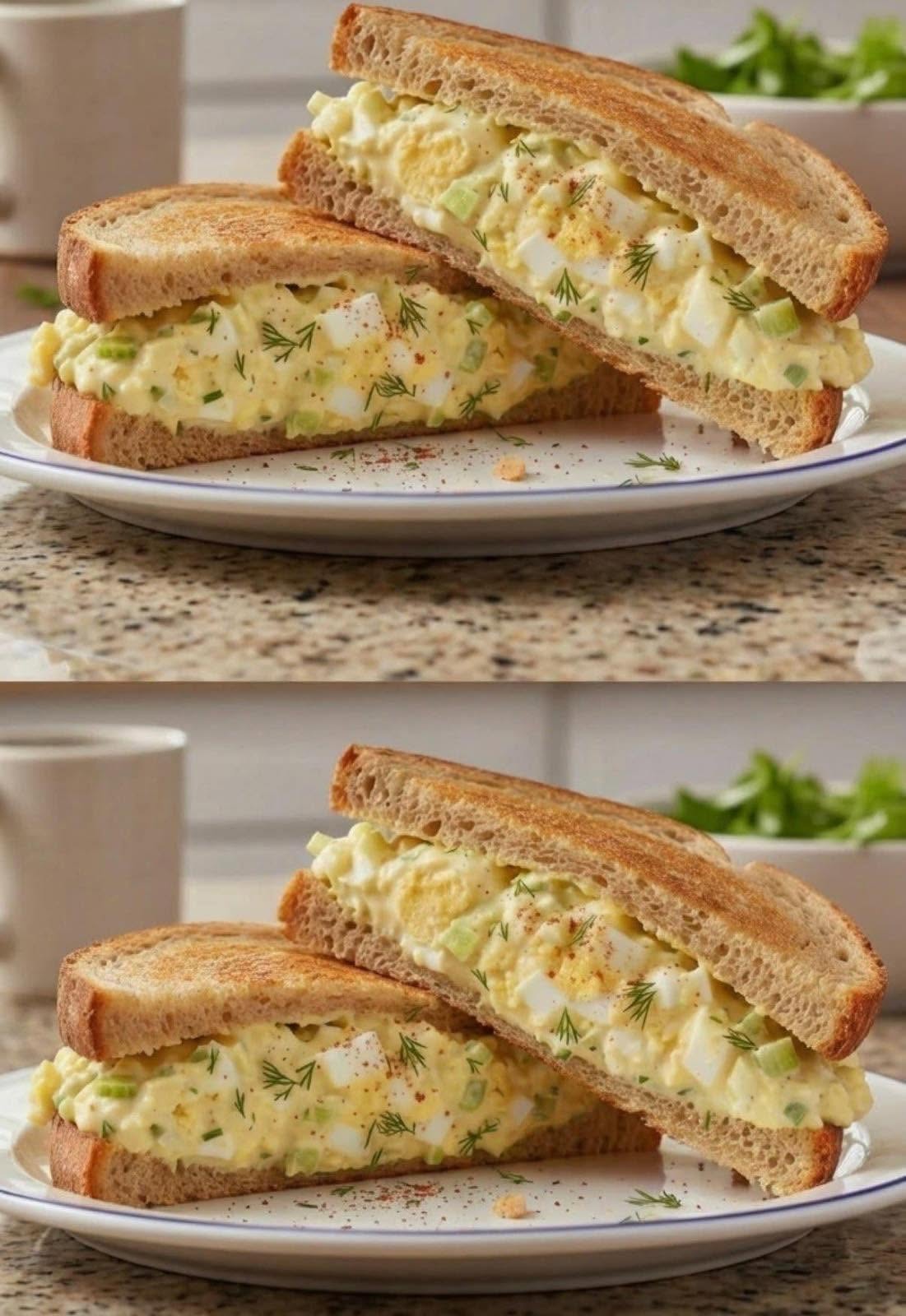
The secret to a café-quality egg salad isn’t a complex list of ingredients—it comes down to textural contrast and acidic balance. By combining a creamy mayo-yogurt dressing, a dash of lemon juice for brightness, and a two-texture egg prep method, this 20-minute recipe yields an egg salad that is rich, bright, and never rubbery or mushy.
Ingredients
For the Eggs
-
Eggs: 8 large, cold from the refrigerator
-
Water & Ice: For boiling and an ice bath
For the Creamy, Balanced Dressing
-
Mayonnaise: ⅓ cup (Duke’s or Hellmann’s preferred)
-
Plain Greek yogurt or sour cream: 2 tablespoons (the chef’s secret for tang and lightness)
-
Dijon mustard: 1 teaspoon
-
Fresh lemon juice or apple cider vinegar: 1 teaspoon
-
Kosher salt: ¼ teaspoon (plus more to taste)
-
Freshly ground black pepper: ⅛ teaspoon
For Texture & Freshness
-
Celery: 2 to 3 tablespoons, finely minced
-
Red onion or chives: 1 tablespoon, finely minced (soaked in cold water for 5 minutes to mellow)
-
Fresh dill, parsley, or chives: 1 tablespoon, finely chopped
The Culinary Science of Tender Egg Salads
-
Egg Protein Coagulation: Egg white proteins (ovalbumin) begin to set at $180^\circ\text{F}$ ($82^\circ\text{C}$). Boiling eggs continuously over high heat causes the proteins to tightly cross-link, creating a rubbery texture and causing iron in the yolk to react with sulfur, forming a green-gray ring of ferrous sulfide. Removing the pot from the heat source to steep at $190^\circ\text{F}$ ensures gentle, tender protein setting.
-
The Two-Texture Mashing Strategy: Mashing 2 of the 8 yolks and whites directly into the dressing creates a thick, rich emulsion. Roughly chopping the remaining 6 eggs provides satisfying structural chunks in every bite.
-
Emulsion Stabilization with Acid: Pure mayonnaise can feel heavy on the palate. Introducing the lactic acid of Greek yogurt along with citric acid from lemon juice cuts through the lipids, creating a lighter emulsion that brightens the egg flavor.
Step-by-Step Instructions:
LOOK NEXT PAGE DEAR──►