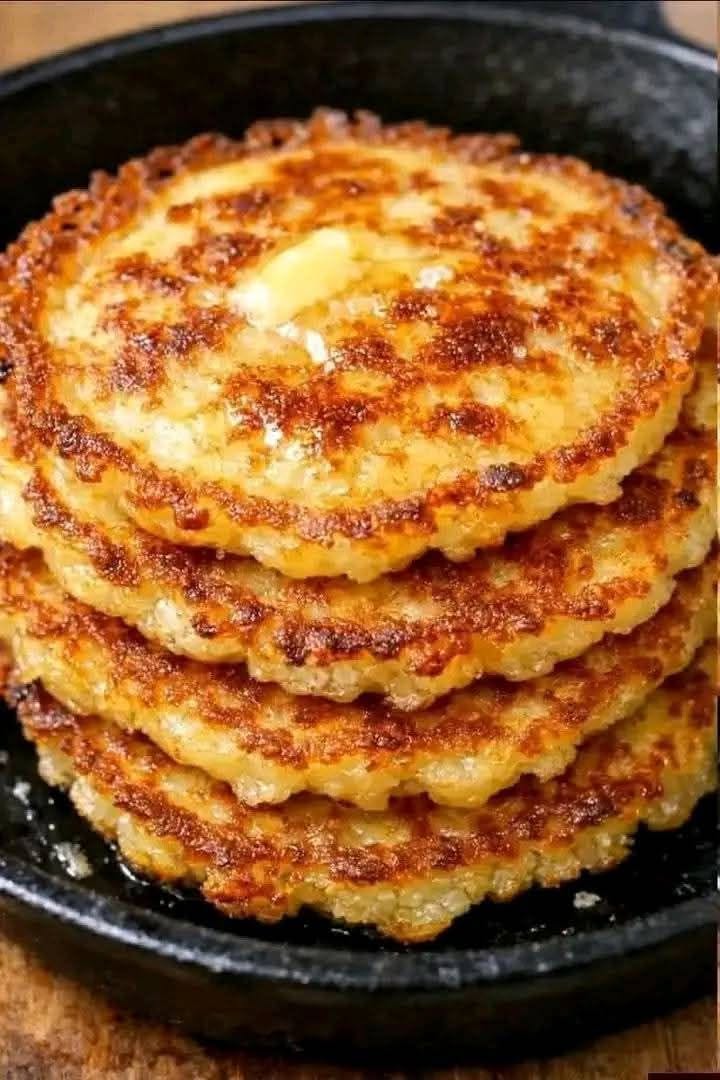
Poor Man Hoecakes are a cherished Southern staple rooted in American agricultural history. Originally baked over open wood fires or outdoor iron hoes by field workers and homesteaders, these simple cornmeal flatbreads rely on humble pantry basics.
Featuring a crispy, golden-brown exterior with a soft, savory interior, hoecakes bridge the gap between traditional cornbread and savory pancakes—making them an effortless side for stews, braised greens, or sweet morning syrup drizzling.
Ingredients
The Structural Grain Base
-
Cornmeal: 1 cup (preferably stone-ground for rich texture and sweet corn aroma)
-
All-purpose flour: ½ cup (provides gluten binder to keep the cakes from crumbling)
-
Baking powder: 1 teaspoon
-
Fine sea salt: ½ teaspoon
The Liquid & Binding Matrix
-
Buttermilk: ¾ cup (or ¾ cup milk combined with 1 tablespoon white vinegar)
-
Egg: 1 large, beaten
-
Unsalted butter: 2 tablespoons, melted
-
Cooking fat: Lard, bacon grease, or vegetable oil (for pan frying)
Optional Garnish Add-ins
-
Sweet Finish: Warm honey or maple syrup
-
Savory Finish: Sliced green onions, fresh parsley, or chopped chives
The Food Science of Hot Skillet Crust Formation
-
Starch Gelatinization & Crisp Edges: When cornmeal batter hits hot pan fat ($350^\circ\text{F}$ to $375^\circ\text{F}$ / $175^\circ\text{C}$ to $190^\circ\text{C}$), surface starches rapidly gelatinize and dehydrate. This immediate moisture loss creates a shatteringly crisp, lace-like perimeter around the hoecake.
-
Maillard Browning & Acid Activation: The lactic acid in buttermilk reacts with the baking powder, producing micro-bubbles of carbon dioxide that puff up the dense corn batter. Concurrently, the amino acids in the egg and flour undergo the Maillard reaction against the hot iron skillet, developing a nutty, toasted flavor profile.
Step-by-Step Instructions:
LOOK NEXT PAGE DEAR──►